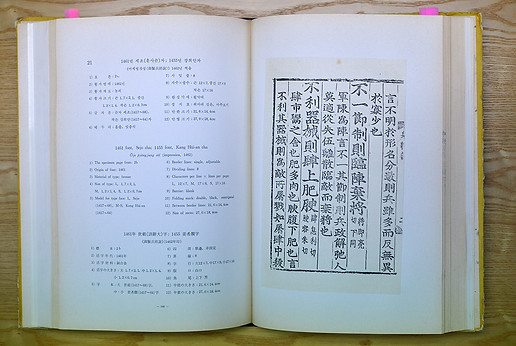
Korean metal type
When I discovered this book in the library during graduate school, I felt as if I'd found an answer sheet. As a novice designer (especially in a foreign country), it provided an opportunity to delve into the often-inaccessible world of Joseon Dynasty bibliography. The book organizes type from the Joseon Dynasty to the modern era by period and provides full-size reprints. The reprints explain the type's age, material, size, and more. Beyond the type itself, the book provides detailed information in Korean, English, and Japanese, including line counts, number of characters, and board thickness.
Most of the typefaces featured here were produced within the palace. Perhaps for this reason, such exquisite calligraphic typefaces have never appeared in Korea, China, or Japan, even after the modern era. Looking at these exquisite typefaces, this graduate student always had a question: Why did printing with type flourish only on the Korean Peninsula? Were our ancestors truly as brilliant as their history teachers taught? Did the Ming Dynasty, boasting the world's most advanced civilization at the time, fail to produce movable typefaces and instead rely on woodblock printing? Looking at these exquisitely crafted movable typefaces, he pondered many things. A cute graduate student...